Wedged between the two most populous giants on the planet, India and China, there is a small kingdom of 38,394 km² (barely bigger than Belgium) perched on the foothills of the eastern Himalayas. A country that invented the concept of Gross National Happiness rather than GDP. A country that stayed closed to tourism until 1974 and still strictly regulates the number of its visitors today. A country more than 70% covered in forest, constitutionally committed to keeping it that way, whose constitution bans deforestation. A country that is the only one in the world with a negative carbon footprint.
Welcome to Bhutan (འབྲུག་ཡུལ་, Druk Yul in Dzongkha, the "Land of the Thunder Dragon").
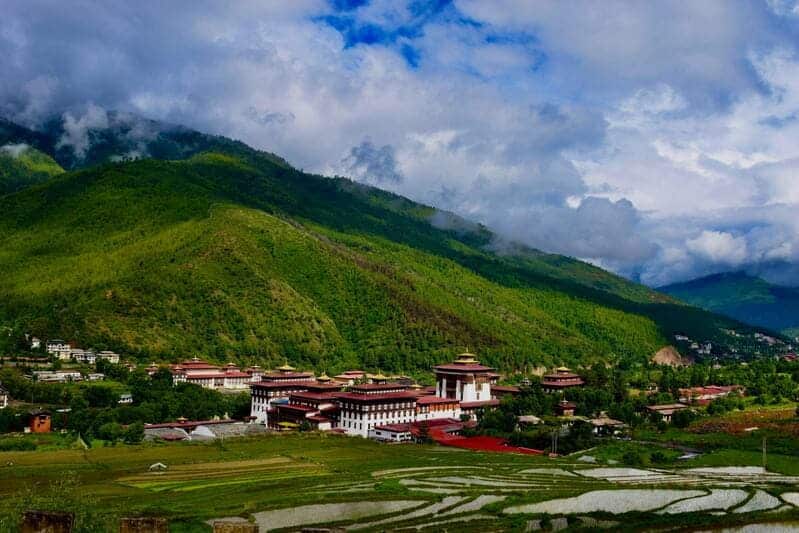
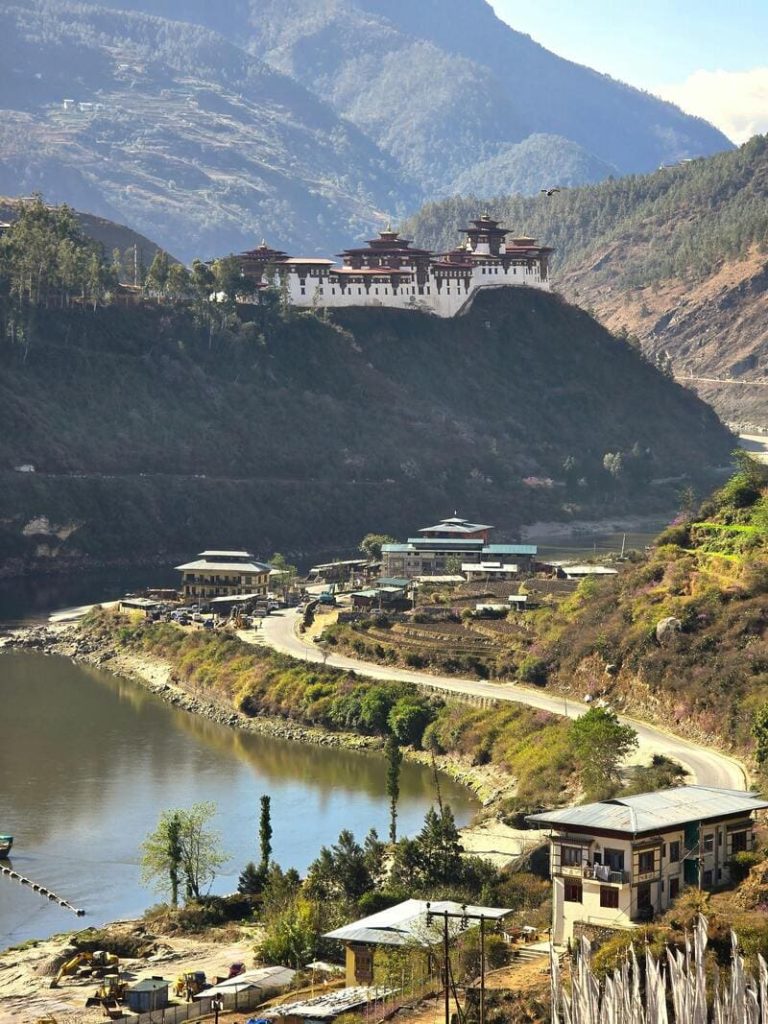
Bhutan fascinates as much as it intrigues. Its spectacular dzongs (fortress-monasteries), unspoilt valleys, monks in crimson robes, traditional architecture required by law and, of course, the legendary Taktsang Monastery (the "Tiger's Nest") clinging to a dizzying cliff at 3,120 metres: together they make a picture of unique beauty and singularity.
But how do you get to Bhutan? It is not like booking a flight to Bangkok or Bali. The country has chosen a deliberately selective and sustainable tourism policy, summed up by the philosophy of "High Value, Low Volume". This means specific formalities, a mandatory daily fee, and a way of organising your trip that is radically different from most Asian destinations.
This guide aims to give you all the practical, checked and up-to-date information you need to understand how to get to Bhutan in 2026, how much it really costs, and how to plan your trip in the best conditions.
Bhutan's tourism system: understand it before you book
Before going into the practical details, it is essential to understand how tourism works in Bhutan, because it is radically different from anything you know.
The "High Value, Low Volume" policy
Since opening to tourism in 1974, Bhutan has always refused mass tourism. The philosophy is clear: few tourists, but tourists who make a significant contribution to the economy and the preservation of the country.
This principle works through two mechanisms:
- The Sustainable Development Fee (SDF): a mandatory daily fee
- The mandatory visa: which can only be obtained after your trip has been organised
The Sustainable Development Fee (SDF): how much it costs
The SDF is the heart of the system. It is a fee per person, per night that every foreign tourist (except citizens of India, Bangladesh and the Maldives) must pay.
History and current amount
| Period | SDF amount | Context |
|---|---|---|
| Before September 2022 | Included in a daily package of $200-250/day (all-inclusive: accommodation, meals, guide, transport, SDF) | Former "all-inclusive" system |
| September 2022 | $200/night (SDF only, excluding accommodation and services) | Major reform: SDF separated from tourist services |
| September 2023 | $100/night (50% reduction, applicable from Sept. 2023 to August 2027) | Adjustment in response to falling visitor numbers |
⚠️ Important: at the time of writing (June 2025), the SDF is set at $100 per night for international tourists (outside SAARC). The Bhutanese government has announced this reduction as valid until August 2027. However, the government can adjust the rates at any time. Always check the current amount when you book on the official website of the Tourism Council of Bhutan or the Department of Tourism.
What the SDF includes (and what it doesn't)
The SDF includes:
- A contribution to Bhutan's free healthcare and free education
- Preservation of the environment and cultural heritage
- Development of tourism infrastructure
- The tourist visa
The SDF does NOT include:
- Accommodation
- Meals
- The guide (mandatory)
- Local transport
- Flights
- Site entry fees
This is a major change from the old system (before 2022), when everything was included in a single package. The SDF is now a pure fee paid to the government, and tourist services (hotel, guide, transport, meals) are booked and paid for separately through your Bhutanese tour operator.
The mandatory guide
Since the 2022 reform, a licensed guide is mandatory for any tourist stay in Bhutan. You cannot travel independently (backpacker style) in the country.
However, the reform has brought more flexibility:
- You can choose your own accommodation (from family guesthouses to 5-star hotels)
- You can plan your own itinerary (in coordination with your guide/operator)
- You can book your meals freely (local restaurants, hotels, etc.)
The guide is still a mandatory companion, but the trip is much more customisable than before.
Bhutan visa: how to apply
Who needs a visa?
All French citizens, like most nationalities, need a visa to enter Bhutan. The only nationalities exempt from the visa (and the SDF) are citizens of India, Bangladesh and the Maldives.
How to get the visa
The Bhutanese visa is inseparable from booking the trip. You cannot get a visa without first booking your stay with a tour operator licensed by the Tourism Council of Bhutan.
Step-by-step procedure
| Step | Action | Details |
|---|---|---|
| 1 | Choose a tour operator | Pick a licensed operator from the Tourism Council of Bhutan's official list (tourism.gov.bt) or go through a tour operator in your country that partners with a Bhutanese operator |
| 2 | Plan the itinerary | In coordination with the operator: length, regions visited, accommodation, activities |
| 3 | Pay the SDF | The SDF must be paid in full before the visa is issued. Payment is made through the operator, which passes it on to the Bhutanese government |
| 4 | Submit the visa application | The operator submits your visa application online to Bhutan's Department of Immigration. Documents required: passport scan (valid for at least 6 months), ID photo, booking confirmation |
| 5 | Get the clearance | The visa is approved in the form of a visa clearance letter sent by email. Processing time: usually a few days to 2 weeks |
| 6 | Visa on arrival | The final visa is stamped in your passport on arrival in Bhutan (Paro airport or a land border) when you show the clearance letter |
Documents required
- Passport valid for at least 6 months after your date of entry
- Recent ID photo (digital format for the online application)
- Visa clearance letter (provided by the operator after the SDF is paid)
- Proof of travel booking (itinerary, accommodation)
Key points
- No direct application: you cannot apply for the visa at an embassy or consulate. Everything goes through the operator.
- No spontaneous visa on arrival: you cannot turn up at Paro airport without a visa clearance letter.
- The visa is non-transferable and tied to your declared itinerary.
- Extensions are possible on site (with additional SDF) by coordinating with your operator.
Source: Department of Immigration, Royal Government of Bhutan. Check the current procedures.
How to get to Bhutan: transport options
This is often the first question people ask, and for good reason: getting to Bhutan is a logistical adventure in itself.
Option 1: by air (the main route)
Paro Airport (PBH)
Paro International Airport is Bhutan's only international airport. And it is one of the most spectacular (and most intimidating) in the world.
Nestled in a narrow valley at 2,236 metres, surrounded by mountains rising above 5,000 metres, Paro airport is ranked among the most difficult airports in the world to land at. Only a handful of pilots worldwide are certified to land there. Landings only take place in daylight and in sufficient visibility (Visual Flight Rules). Weather-related delays and cancellations are therefore common.
Anecdote: the final approach into Paro involves weaving between the mountains, banking into the valley and lining up with the runway at the last moment. If you have a window seat, you will literally see houses and monasteries passing a few dozen metres below the wing. It is spectacular, or terrifying, depending on how you feel about flying.
Airlines serving Paro
Only two airlines are allowed to operate international flights to Paro:
| Airline | Base | Main routes to Paro |
|---|---|---|
| Druk Air (Royal Bhutan Airlines) | Paro | Bangkok, Delhi, Kolkata, Kathmandu, Singapore, Mumbai, Dhaka, Guwahati |
| Bhutan Airlines (Tashi Air) | Paro | Bangkok, Delhi, Kolkata, Kathmandu, Singapore |
⚠️ Note: routes and frequencies change regularly. Some routes are seasonal. Check current routes on the official websites of Druk Air and Bhutan Airlines.
From France: which route?
There are no direct flights between France and Bhutan. You will need to connect through an Asian hub. Here are the most common combinations:
| Route | Transit | Approximate total time | Comment |
|---|---|---|---|
| Paris → Delhi → Paro | Delhi (India) | ~12-15h | The most common option. Many Paris-Delhi flights (Air France, Air India). Then Druk Air or Bhutan Airlines Delhi-Paro (~2h30) |
| Paris → Bangkok → Paro | Bangkok (Thailand) | ~15-18h | A good option if you want a pleasant stopover. Frequent Paris-Bangkok flights. Then Druk Air/Bhutan Airlines Bangkok-Paro (~4h) |
| Paris → Kathmandu → Paro | Kathmandu (Nepal) | ~13-17h | Appealing if you are combining Bhutan + Nepal. Kathmandu-Paro flight ~1h with views of Everest on a clear day! |
| Paris → Singapore → Paro | Singapore | ~16-20h | A comfortable option (Singapore Airlines to Singapore, then Druk Air) |
| Paris → Kolkata → Paro | Kolkata (India) | ~14-17h | Kolkata is the Indian city closest to Paro. Kolkata-Paro flight ~1h |
The Kathmandu-Paro flight: an experience in itself
If you connect through Kathmandu, the flight to Paro (about 1 hour) is one of the most spectacular in commercial aviation. In good weather, you fly over the Himalayan range, potentially including Everest, Kangchenjunga and Makalu, before dropping into the Paro valley between the Bhutanese mountains. Ask for a seat on the left side (flying to Paro) for the best view.
Flight prices to Paro
Flights to Paro are relatively expensive, as the two airlines operate an almost monopoly:
| Route | Indicative one-way fare | Indicative return fare |
|---|---|---|
| Delhi - Paro | ~$250-450 | ~$400-700 |
| Bangkok - Paro | ~$300-500 | ~$500-900 |
| Kathmandu - Paro | ~$200-350 | ~$350-600 |
| Singapore - Paro | ~$350-550 | ~$600-1,000 |
⚠️ These fares are indicative and fluctuate with the season, demand and how far ahead you book. Prices rise significantly in the high season (March-May, September-November). Book as early as possible.
Flight tips
- Book early: planes are small (ATR 42/72 for Bhutan Airlines, A319/A320 for Druk Air) and frequencies limited. In the high season, flights fill up weeks in advance.
- Leave a buffer: weather-related cancellations and delays at Paro are common, especially in the rainy season (June-August). Do not book a tight onward connection from Delhi or Bangkok on the same day as a flight from Paro.
- Cancellation insurance: strongly recommended given the weather risk.
- Luggage: check baggage allowances (often 20-30 kg checked, depending on the airline and class).
Option 2: overland from India
Bhutan shares a long border with India, and several land crossings are open to foreign tourists. It is an interesting alternative, cheaper and sometimes more reliable than flying (no dependence on Paro's weather).
Land entry points
| Crossing | Bhutanese town | Nearest Indian town | Access from India |
|---|---|---|---|
| Phuentsholing | Phuentsholing | Jaigaon (West Bengal) | The most used. Reachable from Siliguri/Bagdogra (~4-5h by road) or Kolkata |
| Gelephu | Gelephu | Assam (India) | South-central Bhutan |
| Samdrup Jongkhar | Samdrup Jongkhar | Assam (India) | Eastern Bhutan |
The Phuentsholing option in detail
Phuentsholing is the most popular land entry point. The town is literally joined to the Indian town of Jaigaon: the border runs across a street.
Typical route from France:
- Flight Paris → Delhi or Kolkata
- Domestic flight to Bagdogra (IXB), the nearest airport (~170 km from Phuentsholing)
- Taxi or bus from Bagdogra to Phuentsholing (~4-5 hours by road)
- Border crossing (visa formalities at the Bhutanese immigration office)
- Road from Phuentsholing to Thimphu (~6 hours, a spectacular and dizzying mountain road)
Advantages:
- Cheaper than flying to Paro
- No weather dependence
- You get to see the spectacular contrast between the Indian plains and the Bhutanese mountains (you climb from ~200 m to over 2,300 m in a few hours)
Disadvantages:
- Long and tiring (the Phuentsholing-Thimphu road is winding and can be hit by landslides in the rainy season)
- Border formalities can be slow
- Transit through India (with its own logistical challenges)
⚠️ Important: even overland, you must have your visa clearance letter obtained in advance through your tour operator. You cannot turn up at the border without prior authorisation.
Option 3: Gelephu airport (project in development)
Gelephu Mindfulness City is a mega development project announced by the King of Bhutan in December 2023. It includes plans for an international airport in Gelephu, in the south of the country. If it goes ahead, it would give Bhutan a second air gateway.
⚠️ Note: at the time of writing (June 2025), this airport is still in the planning/development phase. It is very unlikely to be operational for regular international flights by 2026. Watch for official announcements.
Budget: how much does a trip to Bhutan cost in 2026?
This is THE question, and the answer often scares travellers at first. But let's break it down honestly.
Mandatory costs
| Item | Amount | Comment |
|---|---|---|
| SDF (Sustainable Development Fee) | $100/night | Mandatory, non-negotiable. Paid in advance through the operator. Covers the visa |
| Licensed guide | Variable (included in the operator package) | Mandatory. Usually included in the tour operator's price |
Variable costs
| Item | Indicative range/day | Comment |
|---|---|---|
| Accommodation | $30-80 (guesthouse/3★ hotel) to $200-800+ (luxury hotel: Amankora, Six Senses, etc.) | Wide range. Family guesthouses are the most affordable |
| Meals | $10-20 (local restaurants) to $50-100+ (luxury hotel restaurants) | Bhutanese food is simple but good. Ema datshi (chilli and cheese) is the national dish |
| Transport | $30-80/day (vehicle with driver, shared with the guide) | Mountain roads = short distances but long journey times |
| Entry fees | $5-20 per site | Dzongs, monasteries, museums |
Estimated total budget by profile
| Profile | Budget/day (SDF included) | Budget 7 nights | Budget 10 nights |
|---|---|---|---|
| Tight budget (guesthouse, local meals, simple programme) | ~$170-220/day | ~$1,200-1,500 | ~$1,700-2,200 |
| Mid-range budget (3★ hotel, private guide, full programme) | ~$250-350/day | ~$1,750-2,500 | ~$2,500-3,500 |
| Comfort budget (4-5★ hotel, premium experiences) | ~$400-700/day | ~$2,800-5,000 | ~$4,000-7,000 |
| Luxury budget (Amankora, Six Senses, helicopter) | ~$800-2,000+/day | ~$5,600-14,000+ | ~$8,000-20,000+ |
Add international flights
| Route | Indicative return fare |
|---|---|
| Paris → Delhi + Delhi → Paro | €600-1,200 (total) |
| Paris → Bangkok + Bangkok → Paro | €700-1,400 (total) |
| Paris → Kathmandu + Kathmandu → Paro | €600-1,200 (total) |
Realistic total budget from France (7 nights)
| Profile | All-inclusive estimate |
|---|---|
| Tight budget | €2,000-2,800 |
| Mid-range budget | €3,000-4,500 |
| Comfort budget | €4,500-7,000 |
Yes, Bhutan is expensive. But let's put it in perspective: the $100/night SDF is the price of a mediocre hotel night in Paris. And that money funds free healthcare, free education and environmental protection in a country of 800,000 people that has made the radical choice of sustainability. It is an investment in a model of society, not just a tax.
Tips to cut costs
- Travel as a group: guide and transport costs are shared. A group of 4-6 people significantly reduces the cost per person.
- Choose the low season: some operators offer lower prices in June-August (rainy season) and December-February (winter).
- Go for guesthouses rather than hotels. Bhutanese family guesthouses offer an authentic experience for $30-50/night.
- Eat local: local restaurants are much cheaper than hotel restaurants.
- Compare operators: prices for services (excluding the SDF) vary significantly from one operator to another.
- Combine with Nepal or India: by connecting through Kathmandu or Delhi, you can add a few days in these (much cheaper) countries for a better-balanced overall budget.
What to see and do in Bhutan
The must-sees
🏯 Paro and Taktsang Monastery (Tiger's Nest)
Bhutan's most iconic site, and one of the most photographed in Asia.
Taktsang Monastery (Tiger's Nest) clings to a vertical cliff at 3,120 metres, about 900 metres above the floor of the Paro valley. According to legend, Guru Rinpoche (Padmasambhava), who brought Buddhism to Bhutan in the 8th century, meditated there for three months after arriving on the back of a flying tigress.
The hike: the climb from the car park takes about 2 to 3 hours (uphill), on a well-maintained but steep trail (~600 m of elevation gain). The descent takes 1.5-2 hours. There is no technical difficulty, but you may feel the altitude if you are not acclimatised. Halfway up, a cafeteria offers a spectacular view of the monastery.
Beyond Taktsang, Paro offers:
- Rinpung Dzong: a massive fortress-monastery overlooking the valley
- The National Museum of Bhutan (Ta Dzong): housed in a former watchtower
- The Paro valley: rice paddies, traditional houses, temples
🏯 Thimphu: the capital without traffic lights
Thimphu is the only capital in the world without a single traffic light (a police officer directs traffic at the main junction; an attempt to install a light was abandoned because residents found it "too impersonal").
Worth seeing:
- Tashichho Dzong: the seat of government and the clergy. Monumental architecture.
- The Memorial Chorten: a Buddhist stupa where the faithful gather to turn prayer wheels.
- The Buddha Dordenma: a giant Buddha statue (51 m) overlooking the valley.
- The takin reserve: the takin is Bhutan's national animal, a strange hoofed creature that looks like a cross between a wildebeest and a goat.
- The School of Traditional Arts (Zorig Chusum): students learn Bhutan's 13 traditional arts and crafts.
🏯 Punakha: the most beautiful dzong in the country
Punakha Dzong, at the confluence of two rivers (the Pho Chu and Mo Chu, the "father" and "mother" rivers), is considered the most beautiful dzong in Bhutan. Built in 1637, it is the winter residence of the country's spiritual leader (the Je Khenpo). The interior is spectacular: prayer halls decorated with murals, inner courtyards, a jacaranda garden.
The road from Thimphu to Punakha crosses the Dochula Pass (3,100 m) which, on a clear day, offers a panoramic view of the Himalayan peaks, with 108 memorial stupas in the foreground.
🏯 Bumthang Valley: the spiritual heart
The Bumthang region (in the centre of the country) is the cradle of Bhutanese Buddhism, with an exceptional concentration of ancient temples and monasteries:
- Jambay Lhakhang: one of the oldest temples in Bhutan (7th century)
- Kurjey Lhakhang: three temples, including the one where Guru Rinpoche left his body print in the rock
- Tamshing Lhakhang: a temple founded in 1501, with the oldest murals in the country
- Chumey, Tang and Ura valleys: pastoral landscapes, traditional houses, weaving
Bumthang is also the home of Bhutanese beer and cheese, a Swiss influence (a Swiss cheesemaker lived there for decades). Red Panda beer, brewed in Bumthang, is the best in the country.
🏯 Phobjikha Valley: the valley of the cranes
The Gangtey-Phobjikha valley is a high-altitude glacial valley (~2,900 m) of serene beauty, known as the wintering ground of the black-necked crane (Grus nigricollis), an endangered species that migrates from the Tibetan plateau. From late October to February, 300 to 500 cranes stay in the valley.
The valley also offers:
- Gangtey Goemba: a monastery perched above the valley
- Easy hikes through meadows and bamboo forests
- An atmosphere of absolute calm: one of the most peaceful places in Bhutan
Treks in Bhutan
Bhutan offers several world-famous treks:
| Trek | Duration | Max altitude | Difficulty | Season |
|---|---|---|---|---|
| Druk Path Trek (Paro → Thimphu) | 4-6 days | ~4,200 m | Moderate | March-May, Sept-Nov |
| Jomolhari Trek | 8-10 days | ~4,900 m | Challenging | April-June, Sept-Nov |
| Snowman Trek | 25-30 days | ~5,300 m | Extreme | Sept-Oct only |
| Bumthang Owl Trek | 3-4 days | ~3,600 m | Moderate | March-May, Sept-Nov |
| Dagala Thousand Lakes | 4-6 days | ~4,500 m | Challenging | April-June, Sept-Oct |
The Snowman Trek is regularly cited as one of the hardest treks in the world: fewer than 50% of attempts succeed, mainly because of the weather and altitude.
The Druk Path is the most popular and accessible trek: 4-6 days from Paro to Thimphu through rhododendron forests, high-altitude lakes and yak herders' camps, with breathtaking views of the Himalayan peaks.
When to go to Bhutan: the best seasons
Seasons at a glance
| Period | Conditions | Advantages | Disadvantages | Rating |
|---|---|---|---|---|
| March-May (spring) | 15-25°C in the valleys. Rhododendrons in bloom | Ideal. Spectacular blooms, clear weather, festivals. High season | Some crowds, higher prices | ⭐⭐⭐⭐⭐ |
| June-August (monsoon) | 20-30°C, frequent heavy rain | Lush greenery, few tourists, lower prices | Daily rain, roads sometimes cut (landslides), reduced mountain visibility, leeches on treks | ⭐⭐ |
| Sept-Nov (autumn) | 15-25°C, clear skies | Ideal. Best visibility of the peaks, major festivals (tshechus), stable weather. High season | Some crowds, book well in advance | ⭐⭐⭐⭐⭐ |
| Dec-Feb (winter) | 0-15°C in the valleys, below zero at altitude | Few tourists, clear skies, winter light, snowy landscapes | Cold (especially at night), some passes closed, short days | ⭐⭐⭐ |
The two ideal windows
- Late March to mid-May: the valleys are covered in blooming rhododendrons (the national tree). The weather is usually clear, the peaks visible and the days long. It is also the season of the Paro Tshechu, one of the most spectacular festivals in the country.
- Late September to mid-November: crystal-clear skies, maximum mountain visibility, pleasant temperatures. It is the season of the autumn festivals (notably the Thimphu Tshechu). The light is golden and the rice paddies turn ochre.
The festivals (tshechus): a highlight
Tshechus are Buddhist religious festivals held in dzongs and monasteries across the country. They usually last 3 to 5 days and feature sacred masked dances (cham) performed by monks in elaborate costumes. They are a major social event: Bhutanese people gather in traditional dress (gho for men, kira for women) to share meals and prayers.
The tshechus most accessible to tourists:
| Festival | Place | Approximate period |
|---|---|---|
| Paro Tshechu | Paro | March-April |
| Thimphu Tshechu | Thimphu | September-October |
| Punakha Drubchen & Tshechu | Punakha | February-March |
| Bumthang Jambay Lhakhang Drup | Bumthang | October-November |
⚠️ Note: the exact festival dates follow the Bhutanese lunar calendar and change every year. Check the Tourism Council of Bhutan website for the precise 2026 dates.
Suggested itineraries
🗓️ 5 nights: the essentials of western Bhutan
| Day | Programme | Accommodation |
|---|---|---|
| D1 | Arrival in Paro. Visit Rinpung Dzong and the National Museum. Walk around town | Paro |
| D2 | Hike to the Tiger's Nest (Taktsang). Full day. Rest in the late afternoon | Paro |
| D3 | Drive to Thimphu (~1h30). Visits: Tashichho Dzong, Memorial Chorten, Buddha Dordenma, market | Thimphu |
| D4 | Drive to Punakha via the Dochula Pass (Himalayan view + 108 stupas). Visit Punakha Dzong. Chimi Lhakhang, the Temple of Fertility | Punakha |
| D5 | Return to Paro via Thimphu. Last visits. Craft shopping | Paro |
| D6 | Departure flight from Paro | None |
🗓️ 8 nights: western Bhutan + Phobjikha Valley
| Day | Programme | Accommodation |
|---|---|---|
| D1-D2 | Paro (Taktsang + visits) | Paro |
| D3 | Thimphu (full visit) | Thimphu |
| D4 | Drive to Gangtey/Phobjikha via Dochula. Arrival in the valley. Gangtey Goemba | Phobjikha |
| D5 | Day in the Phobjikha Valley. Gangtey Nature Trail hike. Crane watching (in season) | Phobjikha |
| D6 | Drive to Punakha. Visit Punakha Dzong, Chimi Lhakhang | Punakha |
| D7 | Hike or activity (rafting on the Mo Chu river, if available). Afternoon: drive to Paro | Paro |
| D8 | Free day in Paro. More exploring or rest | Paro |
| D9 | Departure | None |
🗓️ 12 nights: the grand tour (west + centre)
Add to the 8 nights:
| Days | Programme |
|---|---|
| D7-D8 | Domestic flight to Bumthang (or a long 2-day drive via Trongsa). Visit Trongsa Dzong on the way |
| D9-D10 | Bumthang Valley: temples (Jambay, Kurjey, Tamshing), Red Panda brewery, valley hikes |
| D11 | Return to Punakha or Paro (domestic flight or road) |
| D12-D13 | Paro, last visits, departure |
🗓️ The Bhutan + Nepal combo (15-18 days)
To make the most of both budget and experience, many travellers combine:
- 7-10 days in Bhutan
- 5-8 days in Nepal (Kathmandu, Pokhara, a short trek in the Annapurna region)
The Kathmandu-Paro flight links the two countries in 1 hour. Nepal is much cheaper and makes a perfect complement (Hindu and Buddhist culture, trekking, backpacker atmosphere).
Choosing your tour operator
This is a crucial step, since you must go through a licensed operator.
Bhutanese operator vs. agency in your home country
| Option | Advantages | Disadvantages |
|---|---|---|
| Bhutanese operator direct | Usually lower prices (no middleman), direct contact with people on the ground, customisation | Communication can be tricky (time difference, email), no legal protection under your home country's law |
| Specialist agency at home | Support in your own language, legal protection at home (financial guarantee schemes such as APST/ATOUT in France), full follow-up | More expensive (intermediary's margin), less flexibility over local providers |
How to check a Bhutanese operator
- Check that it appears on the Tourism Council of Bhutan's official list (tourism.gov.bt)
- Look for online reviews (TripAdvisor, Google Reviews, travel forums)
- Ask for references from previous travellers
- Check how responsive they are: a good operator replies within 24-48 hours
- Ask for a detailed quote including all costs (SDF, guide, transport, accommodation, meals, entry fees)
- Compare at least 3 quotes before deciding
A few specialist French agencies
Several French agencies offer trips to Bhutan. Among the most established: Tirawa, Atalante, Nomade Aventure, Allibert Trekking (for treks) and Voyageurs du Monde. (This list is for information only and is not a personal recommendation: do your own research and comparisons.)
Practical tips
Health
- Altitude: Thimphu is at 2,320 m and Paro at 2,236 m. If you come from sea level, you may feel slightly out of breath for the first few days. For high-altitude treks (>3,500 m), altitude sickness precautions apply.
- No mandatory vaccines to enter Bhutan. Recommended vaccines: diphtheria-tetanus-polio, hepatitis A and B, typhoid, yellow fever (if transiting through an endemic country).
- Water: do not drink tap water. Bottled water is available everywhere.
- Insurance: essential, with repatriation cover and high-altitude activities if you plan to trek.
Source: Institut Pasteur, Bhutan
Safety
Bhutan is one of the safest countries in the world for travellers. Crime is extremely low, the Bhutanese are legendarily kind, and the presence of the guide removes most logistical risks.
France Diplomatie classes Bhutan as normal vigilance across the whole country.
Source: France Diplomatie, Bhutan
Currency and payments
- The currency is the Bhutanese ngultrum (BTN), pegged to the Indian rupee (1 BTN = 1 INR). Indian rupees are accepted everywhere in Bhutan (except 500 and 2,000 INR notes).
- Cash is essential in most situations. ATMs exist in Thimphu and Paro (Bank of Bhutan), but may be out of order or empty.
- Bank cards are accepted in upmarket hotels and a few shops in Thimphu/Paro. Elsewhere, cash only.
- Change dollars or euros at Paro airport or at banks in Thimphu.
Dress code and customs
- Bhutan is a conservative Buddhist country. Proper dress is required in dzongs and temples: arms and legs covered, hats removed. No shorts, tank tops or short skirts in religious places.
- Bhutanese people wear the gho (men's robe) and the kira (women's dress) every day, and it is mandatory in government buildings and dzongs. Tourists do not have to wear them, but trying one on is a fun experience.
- No tobacco: the sale of tobacco is banned in Bhutan (the first country in the world to do so). You can bring your own cigarettes (limited quantity, customs duty payable), but smoking in public places is forbidden. (Exact rules on importing tobacco may vary: ask your operator.)
- Photography: ask permission before photographing monks and worshippers. Photography is often forbidden inside temples.
Connectivity
- Mobile coverage (4G) is decent in Thimphu, Paro and the main towns. In rural areas and on treks, there is no signal.
- Wi-Fi is available in most hotels.
- Local operators: TashiCell and B-Mobile. You can get a local SIM card at Paro airport.
Electricity
- Type D, F and G plugs (Indian and European types). A universal adapter is recommended.
- Power cuts are possible, especially in rural areas.
Frequently asked questions (FAQ)
Can you travel to Bhutan without a tour operator?
No. Since the 2022 reform, a licensed guide (and therefore a tour operator) is mandatory for all international tourists (except citizens of India, Bangladesh and the Maldives). You cannot travel as an "independent backpacker" in Bhutan. However, you now have more flexibility to choose your accommodation, restaurants and itinerary.
Is the $100/night fee really mandatory?
Yes. The $100/night Sustainable Development Fee (SDF) is mandatory for all international tourists (except Indian, Bangladeshi and Maldivian citizens). It is paid in advance through your tour operator and is a prerequisite for getting the visa. This amount is valid until August 2027 (subject to change by the government). It does not include accommodation, meals, the guide or transport.
Is Bhutan dangerous?
No. Bhutan is one of the safest countries in the world. Crime is almost non-existent, the people are peaceful and welcoming, and the mandatory guide system adds extra security. France Diplomatie classes the country as normal vigilance. The only risks are mountain-related (altitude, weather) for trekkers, and the winding roads.
How long do you need to visit Bhutan?
A minimum of 5 nights lets you see the essentials of western Bhutan (Paro, Thimphu, Punakha). 7 to 10 nights let you add the Phobjikha Valley and/or Bumthang. 14 nights or more are needed for the big treks (Druk Path, Jomolhari) or to explore central and eastern Bhutan.
What is the best time to visit Bhutan?
March-May (spring, rhododendrons in bloom) and September-November (autumn, clear skies, festivals) are the two ideal windows. Avoid June-August (monsoon) unless you are looking for solitude and low prices.
Is Bhutan worth the price?
It is subjective, but the answer from travellers who have been is almost unanimously yes. Bhutan offers a unique experience: an entire country that has made the conscious choice of cultural and environmental preservation over unbridled economic growth. The landscapes, architecture, spirituality, the kindness of the people and the feeling of being somewhere "out of time" justify the cost for most visitors. It is a trip that changes you.
Do children pay the SDF?
Children under 6 are exempt from the SDF. Children aged 6 to 12 get a reduction (the exact amount may vary: check with your operator and on the Tourism Council of Bhutan's official website).
Do you need to be fit?
For a classic tour (dzong visits, walks), normal fitness is enough. The Tiger's Nest hike takes about 5-6 hours of walking with 600 m of elevation gain, manageable for anyone used to walking. For treks (Druk Path, Jomolhari, Snowman), good fitness and mountain hiking experience are needed.
The philosophy of Gross National Happiness: what you will experience
You cannot write about Bhutan without mentioning Gross National Happiness (GNH), the concept invented by Bhutan's 4th king, Jigme Singye Wangchuck, in the 1970s.
GNH rests on four pillars:
- Sustainable and equitable socio-economic development
- Preservation and promotion of culture
- Environmental conservation
- Good governance
This is not a marketing slogan. It is written into Bhutan's Constitution (2008). Every public policy is assessed on its impact on citizens' happiness, not only on economic growth.
What this means in practice for you as a traveller:
- Traditional architecture is mandatory: every building, even a modern hotel, must follow Bhutanese architectural codes (painted windows, shingle roofs, decorated facades). The result: no visual pollution, no ugly concrete blocks.
- Nature is protected: more than 70% of the country is covered in forest, and the country is constitutionally committed to keeping at least 60% forest cover. National parks cover more than 50% of the country.
- Culture is alive: Bhutanese people wear traditional dress every day (not just for tourists), religious festivals mark the year, archery is the national sport, and Buddhism permeates every aspect of life.
- Plastic is limited: Bhutan has banned plastic bags since 1999. Plastic water bottles are still around, but the country encourages reusable bottles.
Travelling in Bhutan means visiting a country that has made a radical choice of civilisation, and seeing on the ground that this choice produces something tangible: a sense of coherence, serenity and authenticity you will not find anywhere else.
Find all our guides by clicking HERE.